

Legendary Fire Instructors Converge in Colorado Springs Focused on Interior Attacks in High-Rise and Big-Box Fires

More Air More Time
Dave McGrail
Capt. Clark Lamping
Capt. Jimmy Davis
Fire in the Sky 2026 Unites Veterans from FDNY, Chicago, Seattle, Denver and Beyond for Three Days of High-Rise and Large-Structure Operations Training
Collaboration is the key to share information.”
COLORADO SPRINGS, CO, UNITED STATES, March 18, 2026 /EINPresswire.com/ -- The seats at Hotel Polaris were full before 8 a.m. Firefighters from 16 states — department patches on their sleeves, years of calls behind their eyes — settled in for the first day of Fire in the Sky 2026. The conference was already sold out. That alone tells you something.— Capt. Jimmy Davis, Chicago Fire Department
Fire in the Sky is hosted by the Firefighter Air Coalition in partnership with the Colorado Springs Fire Department. It is not a conference in the way that word usually gets used — panels of speakers, PowerPoints, networking lunch. This is three days of straight education from people who have worked some of the hardest fires in the country, in buildings that most departments will never see in a full career. They came to Colorado Springs to share what they know. And the people in those seats came ready to listen.
The venue matters, too. Hotel Polaris is the first and only hotel in Colorado with a fully installed air standpipe system built specifically for firefighting operations. Attendees don't just hear about it — they walk the stairwells, put their hands on the connection points, and see what it looks like when a building is actually designed with the firefighters protecting it in mind.
The Standard Gets Set Early
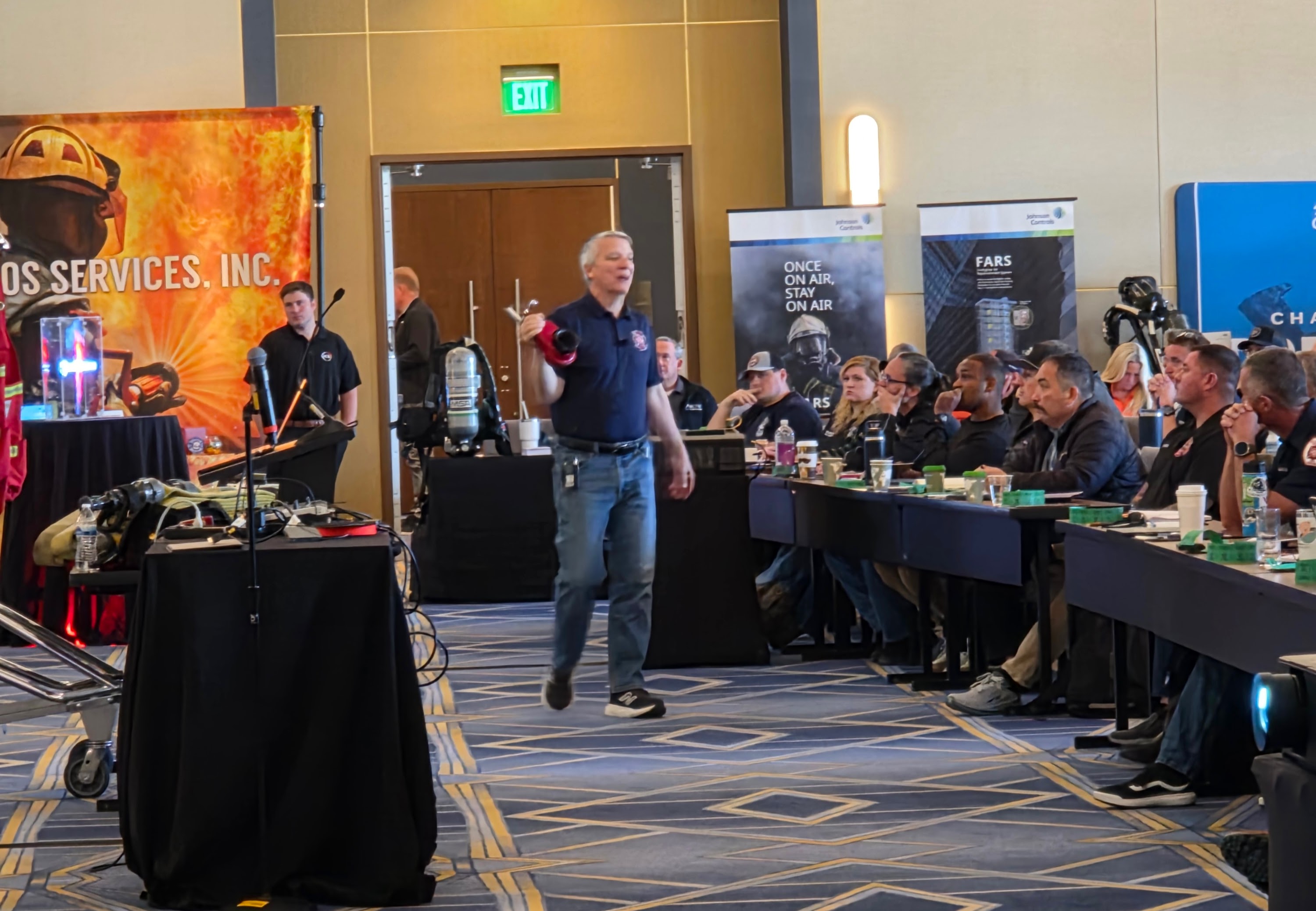
The morning opened with Dave McGrail.
Forty-one years in the fire service. Five with Aurora, Colorado, starting in 1982. Thirty-six more with the Denver Fire Department, where he worked some of the busiest companies in the city and responded to thousands of fires and emergency incidents — including high-rise calls that would make most departments rethink their entire approach. He retired from Denver in 2023. He has not stopped working since.
McGrail is also an author. His textbook, Firefighting Operations in High-Rise and Standpipe-Equipped Buildings, published by Fire Engineering Books in 2007, is one of the defining references in the field. It didn't come from theory. It came from years of standing in stairwells and standpipe closets inside burning buildings, figuring out what actually works under pressure.
His academic credentials are just as serious— two Associate degrees in Fire Science Technology, two Bachelor of Science degrees in Human Resource Management and Fire Service/Public Administration. But the reason the room went quiet when he walked to the podium wasn't the résumé. It was the weight of someone who has earned every word he says.
His session — "High Rise Operations: Mindset Not Myths / Standpipe Operations: Over Analysis = Paralysis" — cuts at something real. The course is built around a straightforward argument: firefighters already know what needs to be done. The equipment is known. The procedures exist. What kills operations isn't ignorance — it's overthinking. When standpipe tactics get buried under layers of analysis and second-guessing, they collapse exactly when they're needed most. McGrail's approach strips it back to what works, builds a continuous hands-on training program around engine company standpipe operations, and keeps the objective simple: overwhelm the enemy.
He closed his session with the line the room will carry home:
"Operational Mindset — it's all about the training process, and it's based on repetitive habits, at daily, high-frequency incidents that usually end as benign, unremarkable events. Remember, it's all about the process."
That is the thing about legends. They don't say things that are complicated. They say things that are true and say them clearly enough that you don't forget them.
What that means for the rest of us: every routine call a firefighter answers — every alarm that turns out to be nothing, every small kitchen fire— is a repetition – it’s training. And repetitions are what build the automatic, practiced response that shows up when the building is actually on fire and there's no time to think. The training that happens on ordinary days is what keeps people alive on extraordinary ones.
When the Air Runs Out
Mike Gagliano and Mike Dugan came to the stage with a combined 78 years of fire service between them and a single, urgent message.
Gagliano spent more than 33 years with the Seattle Fire Department and the United States Air Force. He is the president of the Firefighter Air Coalition — the organization that built and runs Fire in the Sky — and a co-author of Air Management for the Fire Service, a book that has genuinely changed how departments across the country think about the most basic resource a firefighter carries into a building: air. He sits on the Fire Engineering/FDIC Advisory Board and the Emeritus Board of the Firefighter Safety Research Institute.
Dugan's record is its own chapter. Twenty-seven years with the Fire Department of New York, retiring as Captain of Ladder Company 123. As a firefighter with Ladder 43, he earned the James Gordon Bennett Medal and the Harry M. Archer Medal — the FDNY's highest recognition for bravery — back-to-back in 1992 and 1993. He developed training programs that went out to every member of the largest fire department in the United States. He has spent years teaching Truck Company Operations and the impact of building construction on firefighter survival to departments coast to coast. In 2021, he received the Tommy Brennan Lifetime Achievement Award, one of the most meaningful honors in American firefighting.
Their session — "Lost, Disoriented and Out of Air: Air Management in Large Structures" — is an honest look at what happens to firefighters when the building works against them. How smoke moves through large structures. What it does to visibility, to orientation, to decision-making. The logistical realities of getting air where it needs to go when the fire floor is twenty stories up. And the role the air standpipe system plays in turning an impossible situation into a manageable one.
Dugan put it plainly: "You cannot train your way past the need for air infrastructure in tall buildings. A firefighter ascending 30 floors will consume air. Training can reduce waste — but only engineering can provide firefighters with air resupply in these structures."
For anyone who lives or works above the third floor of a building: that sentence is about you. The firefighters coming to find you are racing a clock that started the moment the alarm went off. How your building was designed — whether anyone thought about what the people going in to protect it would actually need — determines how much of that clock is left when they reach your floor.
Five Minutes That Change Everything
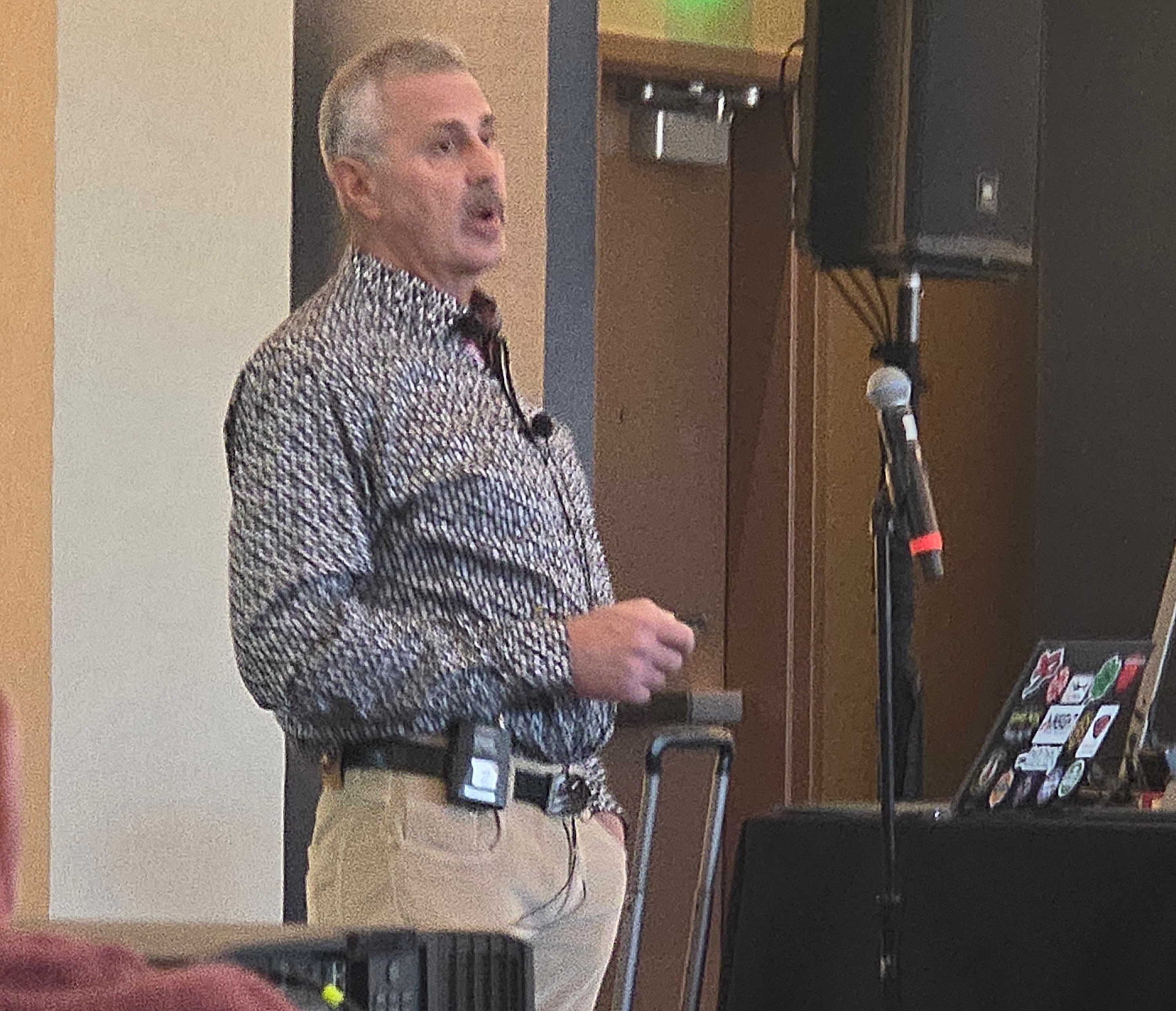
Captain Jimmy Davis of the Chicago Fire Department has spent 30 years in one of the most vertical fire environments in the country. He teaches at the Chicago Fire Department's R.J. Quinn Fire Academy and has presented on high-rise strategy nationally and internationally. He is a technical panel member for UL's Firefighter Safety Research Institute, contributing to research on fire dynamics in multi-story residential buildings.
His session — "Protecting Vertical Cities: The First 5 Minutes" — is about the window that never comes back. When a high-rise reports a fire, the decisions and actions taken in the first five minutes set the conditions for everything that follows. The building's systems either work with the firefighters or against them. The air either holds or it doesn't. The location gets identified or it doesn't.
Davis frames the danger with three words that every city planner, building manager, and high-rise resident should know: the three U's that define the most perilous high-rise fires.
Unprepared.
Unfamiliar.
Untrained.
High-rise fires are rare in many cities and that rarity is the problem. Because they don't happen often, preparation for them can quietly erode. Building layouts become unfamiliar. Standpipe systems get rusty in muscle memory if not in reality. Smoke behavior across 30 floors of a mixed-use tower behaves nothing like smoke in a wood-frame house — and if a crew hasn't trained for the difference, the first five minutes can be spent getting their bearings instead of getting to work.
The civilian translation is straightforward. If you live in a high-rise, know your building's exit routes. Know where the stairwells are. Understand that in a high-rise fire, elevators are off the table. Know that the firefighters who are coming for you have a finite amount of time and air, and that every floor they have to climb before they reach you costs both. Buildings that are designed well — like Hotel Polaris with its air standpipe system — give those firefighters a real fighting chance. Buildings that aren't designed with those realities in mind don't.
The Buildings That Could Eat You Alive
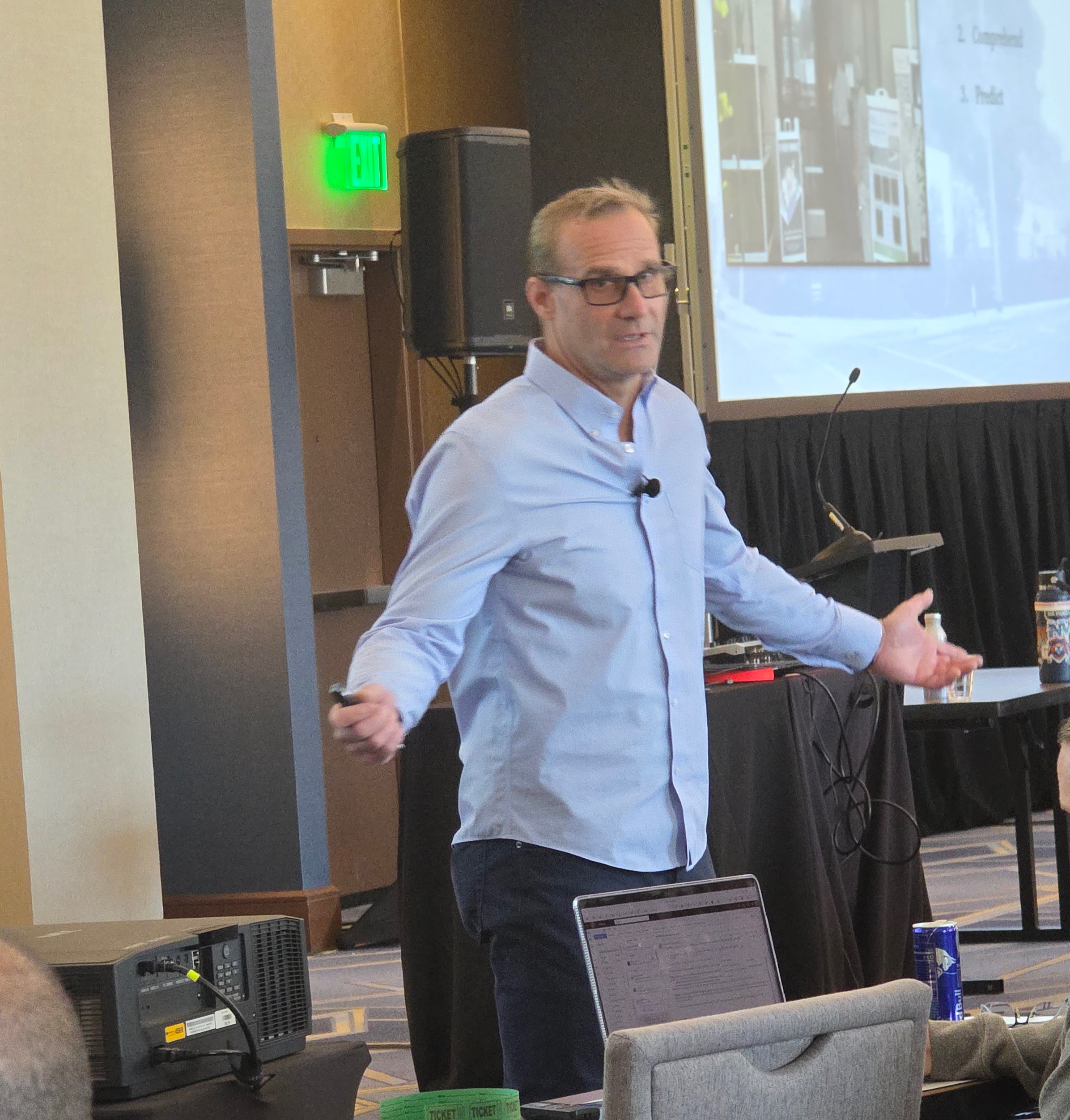
Captain Clark Lamping of the Clark County Fire Department closed out Day One — and left the room thinking about a different kind of structure entirely.
Lamping has spent more than two decades in fire service, including over ten years as a company officer and time as a rescue specialist with Nevada Task Force 1. He works in the Las Vegas metro, which means he doesn't just know casino towers and hotel corridors. Clark County covers some of the largest warehouse and distribution center footprints in the American West — the kind of sprawling, cavernous buildings that have quietly become one of the most dangerous environments in modern firefighting.
His session — "Big Box Fires: Big Problems" — did not let the audience get comfortable.
The big box fire problem is not the same as the high-rise problem. It is, in some ways, harder to grasp because these buildings don't look dramatic. A warehouse is a warehouse. But inside that warehouse might be a million square feet of floor space, rack storage stacked to the ceiling, and a seat-of-the-fire that could be a quarter mile from the nearest door. The hose stretch alone becomes a mission. Air consumption climbs before a single drop of water flows.
The program describes the course directly: "History has repeatedly shown us that taking residential tactics and strategies into a commercial structure is extremely dangerous. These buildings have their own fire behavior, their own storage configurations, their own collapse risk — and their own set of tactical decisions that have nothing to do with the house fire down the street."
Lamping walked through the fire protection systems inside these structures — their strengths, their failure points, and how to use them. He covered how occupants behave during commercial structure emergencies, the command-level considerations for extended operations, and the case studies of significant fatal and near-miss fires that have happened in big-box and distribution center environments across the country.
Why does this matter outside the fire station? Because these buildings are everywhere. The warehouse that ships your online orders. The big-box retailer where you buy groceries. The cold storage distribution center on the edge of town. They employ thousands of people. They sit in every community. And when they burn — which they do — the firefighters going in to protect those workers and contain that fire are walking into an environment that demands a level of preparation most people never think about.
Lamping's session was a reminder that the training happening inside that sold-out ballroom has real consequences for real people in buildings they visit every week without a second thought.
Day One in the Books
By the time the final session wrapped, Day One of Fire in the Sky 2026 had covered more operational ground than most departments see in a year of training. McGrail's foundational discipline. Gagliano and Dugan's honest accounting of what air means in tall buildings. Davis's five-minute window that changes everything in a vertical city. And Lamping's frank look at the sprawling structures that don't make the news until they do.
Two days remain. The building and the student knowledge in that room is already changing.
Shawn Longerich
Firefighter Air Coalition
+1 317-690-2542
email us here
Visit us on social media:
LinkedIn
Instagram
Facebook
YouTube
Legal Disclaimer:
EIN Presswire provides this news content "as is" without warranty of any kind. We do not accept any responsibility or liability for the accuracy, content, images, videos, licenses, completeness, legality, or reliability of the information contained in this article. If you have any complaints or copyright issues related to this article, kindly contact the author above.
