

Global Bamboo Fiber Tableware Market to Hit USD 740.92 million by 2036, Asia Pacific Leads, Bambu Home, EcoSouLife
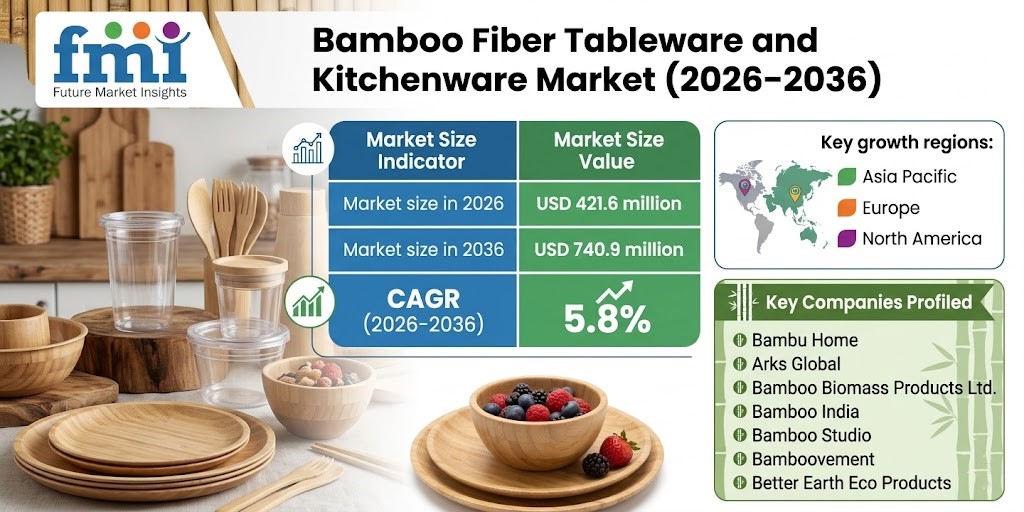
Bamboo Fiber Tableware and Kitchenware Market
Rising demand for biodegradable, plant-based alternatives to plastic tableware accelerates global market expansion
NEWARK, DE, UNITED STATES, March 25, 2026 /EINPresswire.com/ -- The global bamboo fiber tableware and kitchenware market is projected to grow steadily over the next decade, expanding from USD 421.61 Million in 2026 to USD USD 740.92 Million by 2036, registering a CAGR of 5.8%, according to the latest analysis by Future Market Insights (FMI). Growth is driven by increasing consumer preference for sustainable, biodegradable alternatives to plastic and melamine products, alongside regulatory enforcement of single-use plastic bans across major economies.
Traditional plastic and melamine tableware continue to face mounting environmental and regulatory challenges related to non-biodegradability, waste accumulation, and food safety concerns. Bamboo fiber composites address these issues through renewable sourcing, lower environmental impact, and suitability for both residential and commercial applications—making them increasingly essential in modern kitchenware and dining solutions.
Bamboo Fiber Tableware and Kitchenware Market Snapshot (2026–2036)
• Market size in 2026: USD 421.61 Million
• Market size in 2036: USD 740.92 Million
• CAGR (2026–2036): 5.8%
• Leading product type: Tableware (~61.3% share)
• Dominant end-use segment: Residential (~68.7% share)
• Key growth regions: Asia Pacific, Europe, North America
• Fastest-growing countries: China, India, Germany, France, UK
Request For Sample Report | Customize Report |purchase Full Report – https://www.futuremarketinsights.com/reports/sample/rep-gb-23046
Market Momentum
The bamboo fiber tableware and kitchenware market begins at approximately USD 421.6 million in 2026 and maintains a steady growth trajectory throughout the forecast period. By 2031, rising consumer awareness, retail expansion, and regulatory pressures push market value beyond USD 580 million.
Between 2031 and 2036, growth accelerates as commercial foodservice adoption increases, product innovation expands into premium categories, and sustainability commitments from brands and retailers strengthen demand. By 2036, the market reaches USD 740.9 million, sustaining a 5.8% CAGR over the decade.
Why the Market Is Growing
Demand for bamboo fiber tableware and kitchenware is increasing due to its role in delivering sustainability, safety, and aesthetic appeal across residential and commercial applications. Consumers are prioritizing eco-friendly materials that reduce plastic usage while maintaining durability and design quality.
Regulatory enforcement of single-use plastic bans across Europe, Asia, and North America is accelerating the shift toward reusable bamboo fiber products.
At the same time, commercial foodservice operators are adopting bamboo tableware to meet sustainability targets and enhance brand positioning.
Advancements in bamboo composite technology are expanding product capabilities into heat-resistant utensils, insulated serving ware, and premium dining sets. Material selection is increasingly driven by environmental impact, lifecycle cost efficiency, and compliance with food-contact safety standards.
Segment Spotlight
• Product Type: Tableware Leads with ~61.3% Share
Tableware dominates market demand due to high-volume consumption of plates, bowls, and cups replacing plastic alternatives in both residential and commercial settings. Kitchenware products such as utensils, cutting boards, and storage containers are gaining traction with innovation in durability and design.
• End-Use: Residential Segment Anchors Demand (~68.7% Share)
Residential consumers represent the largest segment, driven by increasing awareness of sustainable living and widespread availability through retail and e-commerce channels. Commercial adoption is expanding steadily, particularly in hospitality and foodservice sectors.
• Distribution Channel: Offline Maintains Strong Presence (~54.9% Share)
Offline retail channels lead due to consumer preference for physical product evaluation, supported by in-store promotions and growing shelf space for eco-friendly products. Meanwhile, online channels are gaining momentum through curated collections and direct-to-consumer brands.
Regional Growth: Asia Pacific, Europe, and North America Drive Expansion
Asia Pacific remains the leading growth hub, with China and India benefiting from strong manufacturing ecosystems, abundant bamboo resources, and rising domestic demand.
Europe is experiencing steady growth supported by stringent plastic regulations and consumer preference for certified sustainable products. North America advances through municipal plastic bans and growing adoption of eco-friendly kitchenware in households and foodservice operations.
Drivers, Opportunities, Trends, Challenges
Drivers:
• Regulatory bans on single-use plastics
• Rising eco-conscious consumer behavior
• Expansion of sustainable product retail categories
Opportunities:
• Premium bamboo composite designs and customization
• Commercial foodservice adoption
• E-commerce and global retail expansion
Trends:
• Shift toward reusable and biodegradable tableware
• Growth in design-oriented and aesthetic product offerings
• Increasing focus on food-contact safety certifications
Challenges:
• High production and processing costs
• Raw material and labor price fluctuations
• Regulatory compliance for food safety standards
Competitive Landscape
The bamboo fiber tableware and kitchenware market is fragmented, with competition centered on product innovation, sustainability credentials, and design differentiation. Companies are strengthening their market presence through eco-friendly product portfolios, advanced material technologies, and expanded distribution networks.
Leading manufacturers include Bambu Home, Arks Global, Bamboo Biomass Products Ltd., Bamboo India, Bamboo Studio, Bamboovement, Better Earth Eco Products, ChopValue Manufacturing Ltd., Ecolife Innovations Ltd., EcoSouLife, Ekobo, Green Pioneer, and Natural Home Brands.
These players compete on product durability, food safety compliance, aesthetic design, and sustainability positioning while targeting both residential consumers and commercial buyers globally.
Frequently Asked Questions (FAQs)
1. What is the market size of bamboo fiber tableware and kitchenware in 2026?
The market is estimated to be valued at USD 421.6 million in 2026.
2. What will be the market size by 2036?
The market is projected to reach USD 740.9 million by 2036.
3. What is the expected CAGR from 2026 to 2036?
The market is expected to grow at a CAGR of 5.8% during the forecast period.
4. Which segment leads the market?
Tableware leads with around 61.3% share, driven by high demand for plates, bowls, and cups.
5. What is driving market growth?
Growth is driven by rising demand for eco-friendly products, plastic bans, and increasing consumer awareness of sustainability.
Why FMI: https://www.futuremarketinsights.com/why-fmi
Explore more research reports by FMI
Car Seat and Accessory Market: https://www.futuremarketinsights.com/reports/car-seat-and-accessories-market
Smart Home Refillable IAQ Air Filters Market: https://www.futuremarketinsights.com/reports/smart-home-refillable-iaq-air-filters-market
Floor Power Grommets Market: https://www.futuremarketinsights.com/reports/floor-power-grommets-market
About Future Market Insights (FMI)
Future Market Insights, Inc. (FMI) is an ESOMAR-certified, ISO 9001:2015 market research and consulting organization, trusted by Fortune 500 clients and global enterprises. With operations in the U.S., UK, India, and Dubai, FMI provides data-backed insights and strategic intelligence across 30+ industries and 1200 markets worldwide.
Sudip Saha
Future Market Insights Inc.
+1 347-918-3531
email us here
Legal Disclaimer:
EIN Presswire provides this news content "as is" without warranty of any kind. We do not accept any responsibility or liability for the accuracy, content, images, videos, licenses, completeness, legality, or reliability of the information contained in this article. If you have any complaints or copyright issues related to this article, kindly contact the author above.
