

Thyroid Function Test (TFT) Market Expands at 4.5% CAGR Through 2033 | Persistence Market Research
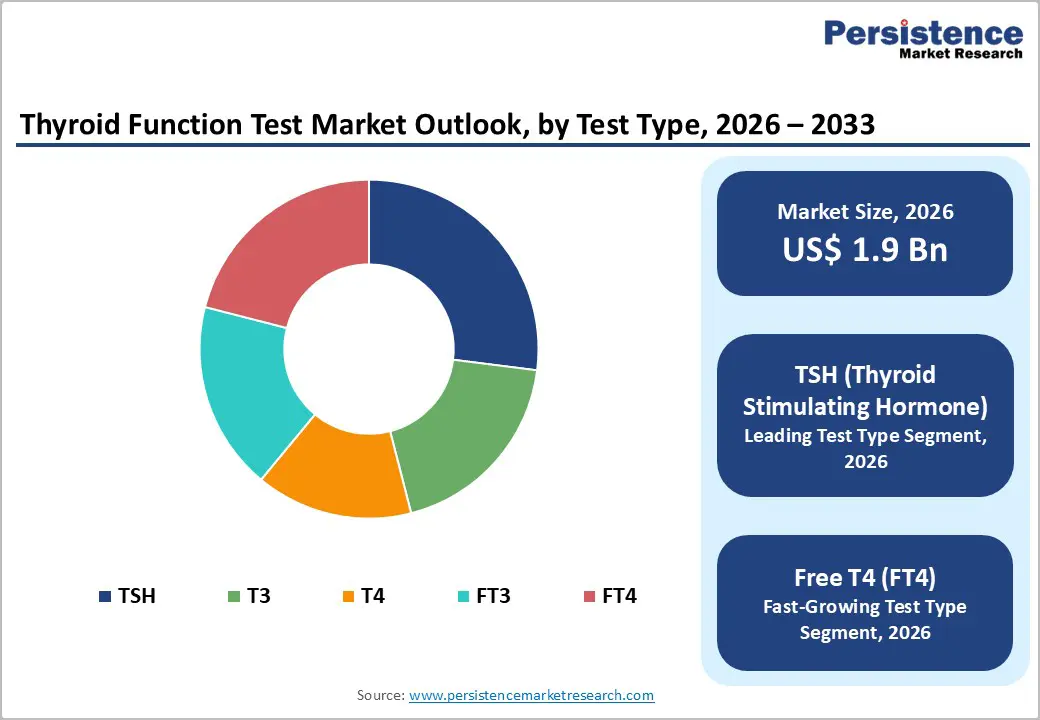
Thyroid Function Test (TFT) market
Global thyroid function test market is driven by rising thyroid disorders, advanced diagnostics, and growing focus on early detection and preventive care.
LONDON, UNITED KINGDOM, March 31, 2026 /EINPresswire.com/ -- The global Thyroid Function Test (TFT) market is projected to reach US$ 1.9 billion in 2026 and grow to US$ 2.6 billion by 2033, expanding at a CAGR of 4.5% during the forecast period. This steady growth reflects the increasing global burden of thyroid disorders, coupled with continuous advancements in diagnostic technologies. Rising awareness regarding thyroid health and the importance of early diagnosis are also contributing significantly to market expansion.
The growing prevalence of thyroid-related conditions such as hypothyroidism, hyperthyroidism, and autoimmune thyroid diseases is a primary driver of demand. Increasing adoption of routine health checkups, particularly among aging populations and pregnant women, has further strengthened the need for accurate and timely thyroid testing. Additionally, government-supported newborn screening programs for congenital hypothyroidism are playing a crucial role in boosting testing volumes worldwide.
Download Your Free Sample & Explore Key Insights: https://www.persistencemarketresearch.com/samples/33934
Market Dynamics
One of the key growth drivers is the rising incidence of thyroid disorders globally. Lifestyle changes, iodine imbalance, and genetic predisposition have led to a surge in thyroid-related conditions. Early diagnosis is essential to prevent complications such as cardiovascular diseases, infertility, and metabolic disorders, thereby increasing reliance on thyroid function tests including TSH, Free T4, and Free T3.
Technological advancements in diagnostic platforms have significantly improved the accuracy and efficiency of thyroid testing. Modern immunoassay technologies such as chemiluminescence immunoassay (CLIA) and electrochemiluminescence (ECLIA) enable highly sensitive detection of thyroid hormones, even at very low concentrations. Automated systems now provide faster turnaround times and reduced human error, enhancing overall diagnostic reliability.
However, the market faces certain restraints. Biotin interference in immunoassay testing has emerged as a notable challenge, leading to inaccurate results and potential misdiagnosis. Additionally, lack of standardization across diagnostic platforms creates inconsistencies in results between laboratories. In emerging markets, limited reimbursement policies and high diagnostic costs also restrict widespread adoption, especially in rural areas with limited healthcare infrastructure.
Market Opportunities
Significant opportunities exist in the expansion of government-backed screening programs. Many countries are increasingly implementing universal newborn screening initiatives, ensuring early detection of thyroid disorders. These programs generate consistent testing demand and encourage investments in laboratory infrastructure.
The rising popularity of preventive healthcare is another major opportunity. Consumers are increasingly opting for routine diagnostic screenings, including thyroid testing, as part of overall wellness monitoring. Telemedicine and home-based sample collection methods are also gaining traction, making testing more accessible and convenient.
The growing focus on autoimmune thyroid diseases has led to increased demand for advanced diagnostic markers such as anti-TPO and anti-thyroglobulin antibodies. These tests help identify patients at risk and support early intervention, thereby expanding the scope of thyroid diagnostics.
Get Custom Insights Designed for Your Businecss: https://www.persistencemarketresearch.com/request-customization/33934
Segment Analysis
Among test types, Thyroid Stimulating Hormone (TSH) testing remains the dominant segment, accounting for a significant share of the market. It is widely regarded as the first-line diagnostic tool due to its high sensitivity and cost-effectiveness. TSH testing is commonly used in routine health screenings, newborn testing, and monitoring patients undergoing hormone therapy.
Free T4 (FT4) testing is emerging as the fastest-growing segment. Increasing awareness of complex thyroid conditions and the need for comprehensive diagnostic panels are driving its adoption. Combined testing approaches, including TSH and FT4, are becoming standard practice in many healthcare settings.
From a technology perspective, chemiluminescence immunoassay (CLIA) dominates the market due to its superior sensitivity, rapid processing time, and compatibility with automated systems. These advantages make it ideal for high-throughput laboratories and hospital settings.
In terms of end users, hospitals represent the largest segment, driven by their central role in diagnosis and treatment. Diagnostic laboratories and specialty clinics also contribute significantly, particularly in urban areas with advanced healthcare facilities.
Regional Insights
North America holds the largest share of the thyroid function test market, supported by advanced healthcare infrastructure, strong reimbursement systems, and high awareness levels. The region benefits from widespread adoption of routine screening and innovative diagnostic technologies.
Asia Pacific is the fastest-growing region, driven by increasing healthcare investments, rising disease prevalence, and expanding access to diagnostic services. Rapid urbanization and growing awareness of preventive healthcare are further fueling market growth in countries such as India and China.
Checkout Now & Download Complete Market Report: https://www.persistencemarketresearch.com/checkout/33934
Competitive Landscape
The thyroid function test market is highly competitive, with key players focusing on innovation, strategic partnerships, and geographic expansion. Leading companies are investing heavily in research and development to enhance assay sensitivity and automation capabilities. At the same time, regional players are offering cost-effective solutions to cater to price-sensitive markets.
Market Segmentation
Test Type
TSH
T3
T4
FT3
FT4
Technology
Immunoassays
Chemiluminescence Immunoassay (CLIA)
Radioimmunoassay (RIA)
Enzyme-Linked Immunosorbent Assay (ELISA)
Others
End User
Hospitals
Diagnostic Laboratories
Clinics
Research Institute
Regions
North America
Europe
East Asia
South Asia & Oceania
Latin America
Middle East & Africa
Overall, the thyroid function test market is poised for steady growth, supported by rising disease burden, technological advancements, and increasing emphasis on early diagnosis and preventive healthcare.
Read Related Reports:
Liquid Chromatography-mass Spectroscopy Market: Global liquid chromatography mass spectroscopy market grows from US$7.9 billion in 2026 to US$18.1 billion by 2033, registering a CAGR of 12.6%.
Chemotherapy Drugs Market: The global chemotherapy drugs market set to hit US$ 57.2 billion in 2026 and US$ 104.6 billion by 2033, reflecting a 9% CAGR during the forecast period.
Persistence Market Research
Persistence Market Research Pvt Ltd
+1 646-878-6329
email us here
Visit us on social media:
LinkedIn
Instagram
Facebook
YouTube
X
Legal Disclaimer:
EIN Presswire provides this news content "as is" without warranty of any kind. We do not accept any responsibility or liability for the accuracy, content, images, videos, licenses, completeness, legality, or reliability of the information contained in this article. If you have any complaints or copyright issues related to this article, kindly contact the author above.
