

Why Cities Are Becoming the AI Regulators: Insights from the RegulatingAI Podcast with Giorgia Rambelli & Sanjay Puri

RegulatingAI Podcast
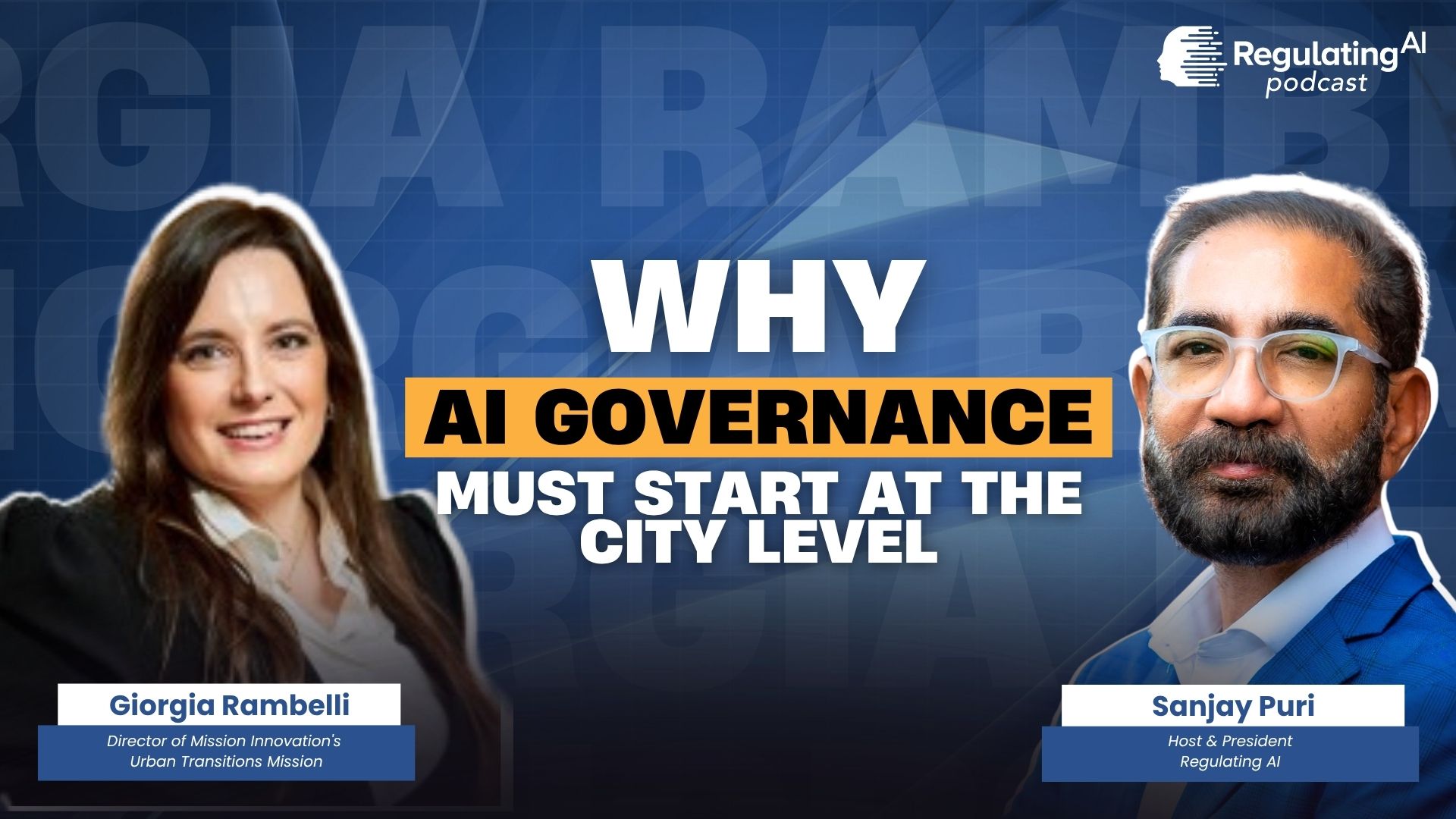
Giorgia Rambelli, Director of Mission Innovation's Urban Transitions Mission, with Sanjay Puri, Host & President, RegulatingAI
Giorgia Rambelli says cities are becoming real AI regulators, using local governance to ensure AI serves public needs & trust on the RegulatingAI Podcast.
Cities: The Unofficial AI Regulators
While national governments draft policies and global institutions set standards, the real action happens at the city level. As Giorgia explains, implementation is where theory meets reality. Cities are deploying AI in high-impact areas like mobility, utilities, and surveillance—often making critical decisions about how these systems operate in practice.
This puts cities in a unique position: they are not just users of AI but de facto regulators. Through tools like public procurement, cities can enforce transparency, demand accountability, and even reject technologies that don’t meet ethical standards. If a vendor fails to comply with requirements like algorithmic transparency or open access, cities can simply refuse contracts.
AI’s Immediate Value for Urban Life
AI’s potential in cities lies in its ability to manage complexity. Urban environments generate vast amounts of data, and AI helps make sense of it. From optimizing water and electricity distribution to enabling electric mobility and predictive urban planning, AI is becoming indispensable.
In rapidly growing regions—especially in the Global South—AI offers even greater value. Cities experiencing explosive growth can use AI for scenario modeling, infrastructure planning, and risk prediction. These tools allow policymakers to anticipate challenges like informal settlements, climate risks, and resource allocation before they escalate.
The Inequality Challenge
However, not all cities are equally equipped to leverage AI. Many municipalities lack the infrastructure, funding, or technical expertise required to deploy advanced systems. This creates a risk of widening inequality between “data-rich” and “capacity-poor” cities.
Giorgia emphasizes the importance of open access and interoperability. Cities should not be locked into proprietary systems or dependent on single vendors. Instead, shared platforms, open datasets, and collaborative models can help level the playing field. Examples like Freetown’s use of existing environmental data show how even resource-constrained cities can innovate effectively.
Governance: Local Context Matters
A key takeaway from the discussion is that AI governance cannot be one-size-fits-all. While national frameworks like the EU AI Act provide important guidelines, cities need localized approaches that reflect their unique social, economic, and cultural contexts.
Cities like Barcelona, Amsterdam, and Helsinki are leading the way by creating AI registries and opening their algorithms to public scrutiny. These initiatives not only enhance transparency but also build public trust and allow for external audits to detect bias.
Importantly, Giorgia Rambelli stresses the need for “human-in-the-loop” decision-making. AI can suggest, predict, and optimize—but it should not replace human judgment. The ultimate decisions must remain with people who understand the societal context and public good.
Data Governance: The Foundation of Trust
Effective AI starts with good data governance. This includes understanding data sources, ensuring quality, identifying biases, and maintaining transparency about how data is used. Cities must also clearly define the purpose of data collection and avoid misuse, such as repurposing surveillance data for unintended applications.
Interoperability across departments is equally critical. Fragmented data systems can lead to inefficiencies and inconsistencies, whereas integrated systems enable better decision-making and coordination.
Leadership and Vision
Adopting AI is not just a technical challenge—it’s a leadership one. City leaders must articulate a clear vision of what they want to achieve and how AI fits into that vision. As Rambelli notes, the goal is not to deploy AI for its own sake, but to solve real problems—whether it’s reducing emissions, improving mobility, or enhancing citizen engagement.
Leadership also plays a crucial role in breaking down silos within municipal departments and fostering collaboration.
The Bottom Line
AI is already reshaping cities, but its success depends on how thoughtfully it is governed. Cities are emerging as powerful actors in this space, capable of shaping not just implementation but also the ethical and operational standards of AI.
As highlighted in the RegulatingAI Podcast with Sanjay Puri and Giorgia Rambelli, the future of AI governance will not be decided solely in national capitals—it will be built, tested, and refined in cities around the world. And at the heart of it all must remain a simple principle: AI should serve people, not replace them.
Upasana Das
Knowledge Networks
email us here
Visit us on social media:
LinkedIn
Instagram
Facebook
YouTube
X
Legal Disclaimer:
EIN Presswire provides this news content "as is" without warranty of any kind. We do not accept any responsibility or liability for the accuracy, content, images, videos, licenses, completeness, legality, or reliability of the information contained in this article. If you have any complaints or copyright issues related to this article, kindly contact the author above.
