

Compostable & Biodegradable Refuse Bags Market Forecast 2036 | Eco-Friendly Packaging Growth & Top Players BioBag, BASF
Compostable & Biodegradable Refuse Bags Market
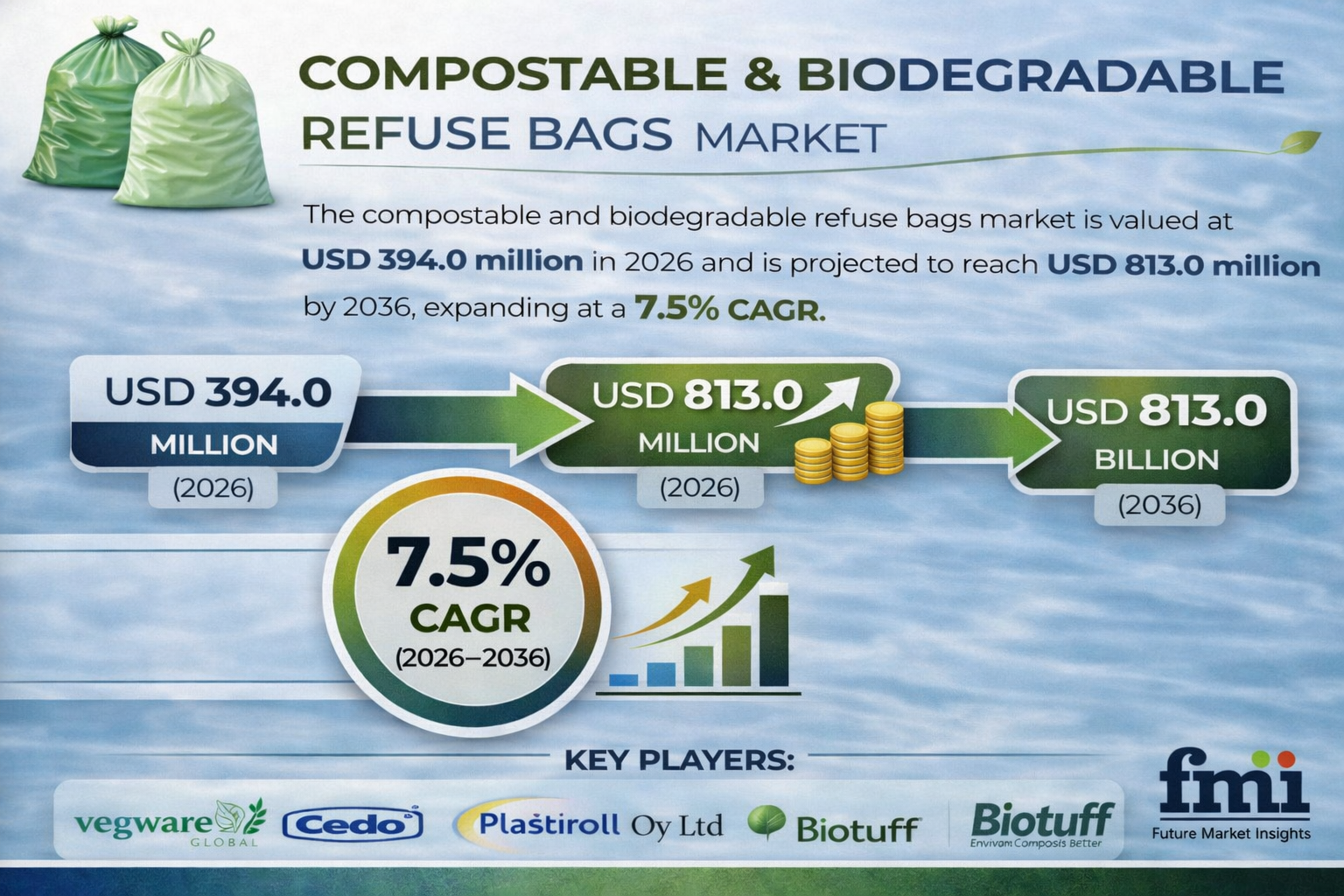
The Compostable & Biodegradable Refuse Bags Market is valued at USD 394.0 mn in 2026 and is projected to reach USD 813.0 mn by 2036, expanding at a 7.5% CAGR.
NEWARK, DE, UNITED STATES, March 31, 2026 /EINPresswire.com/ -- The global compostable and biodegradable refuse bags market is projected to grow from USD 394.0 million in 2026 to USD 813.0 million by 2036, expanding at a CAGR of 7.5%, according to Future Market Insights (FMI). Market expansion is increasingly driven by regulatory enforcement, municipal waste segregation programs, and institutional procurement standards, positioning compostable refuse bags as essential tools in modern waste management systems.
Compliance-Led Procurement Reshaping Market Demand:
The market is undergoing a structural shift from voluntary sustainability adoption to compliance-driven purchasing.
Key demand drivers include:
• Expansion of municipal organics collection programs
• Enforcement of extended producer responsibility (EPR) regulations
• Adoption of zero-waste and landfill diversion targets
• Increasing focus on contamination-free waste streams
Municipalities, healthcare systems, and foodservice operators are prioritizing certified compostable liners that integrate seamlessly with regulated organic waste collection systems.
Transition Toward Certified, Microplastic-Free Solutions:
Product innovation across 2025–2026 highlights a clear move toward:
• Microplastic-free formulations
• PFAS-free material systems
• Certification-backed labeling and traceability
Manufacturers are aligning portfolios with stricter global compliance standards across Europe, North America, and Asia, ensuring compatibility with industrial composting infrastructure.
As noted by industry participants, trust and performance assurance are becoming critical, with users expecting refuse bags that fully degrade without leaving harmful residues.
Get Access of Research Report Sample: https://www.futuremarketinsights.com/reports/sample/rep-gb-7082
Compostable Bags Dominate Product Demand:
Compostable-certified refuse bags account for approximately 54% of total market value, reflecting strong regulatory alignment.
Key advantages include:
• Compatibility with industrial composting systems
• Reduced contamination in organic waste streams
• Compliance with municipal procurement specifications
• Reliable performance in wet waste handling
Institutional buyers increasingly require certification compliance as a prerequisite in procurement contracts.
PLA and Starch Blends Lead Material Adoption:
PLA (polylactic acid) and starch-based blends represent around 42% of material usage, supported by:
• Established processing compatibility
• Scalable film extrusion capabilities
• Balanced cost-performance ratio
• Improved flexibility and tear resistance
These materials enable manufacturers to scale production efficiently while maintaining consistent compostability performance.
Mid-Capacity Bags and Standard Thickness Drive Volume:
Operational efficiency and standardized waste systems are shaping product specifications:
• 20–30 gallon capacity holds ~35% share due to compatibility with municipal bins
• 0.7 to 0.9 mil thickness accounts for ~40% demand, balancing durability and cost
These specifications support daily organic waste handling across households, commercial kitchens, and institutional facilities.
Household Demand Anchors Market, Institutions Accelerate Growth:
End-use segmentation highlights two key demand pillars:
• Retail & household segment (63%):
• Driven by daily kitchen waste disposal
• Supported by growing participation in composting programs
• Institutional demand (rapid growth):
• Foodservice, healthcare, and municipalities
• Driven by compliance requirements and bulk procurement
Compostable refuse bags are increasingly embedded in routine waste management workflows, rather than being optional eco-products.
Digital and B2B Channels Lead Distribution:
Online and institutional procurement channels account for approximately 39% of total sales, reflecting predictable demand cycles.
Key trends include:
• Bulk purchasing and subscription models
• Centralized procurement for multi-site operations
• Integration with compliance documentation systems
These channels strengthen supplier relationships and ensure consistent supply for regulated waste programs.
Regional Outlook: India and China Lead Growth:
Country-level growth varies based on regulatory enforcement and infrastructure readiness:
• India (8.6% CAGR): Strong EPR enforcement and urban waste segregation
• China (8.4% CAGR): Rapid expansion of mandatory waste sorting systems
• Spain (7.5% CAGR): Alignment with EU organic waste targets
• United States (7.1% CAGR): Growth in curbside organics programs
• Germany (6.1%) & UK (5.9%): Mature waste management systems
Asia Pacific is emerging as the primary growth engine, supported by urbanization and policy-driven adoption.
Competitive Landscape: Certification and Performance Over Price:
The market is moderately competitive, with companies focusing on compliance, durability, and supply reliability.
Key players include:
• Vegware Global
• BioBag International AS
• Cedo Ltd.
• Clondalkin Group Holdings B.V.
• Plastiroll Oy Ltd
Competitive strategies center on:
• Certification compliance and audit readiness
• Enhanced puncture resistance and wet-load durability
• Integration with municipal and foodservice waste systems
• Expansion of product portfolios across capacity and formats
Suppliers that secure long-term municipal contracts and institutional supply agreements are best positioned for sustained growth.
Key Trends Shaping the Industry:
• Standardization of compostability certifications and labeling
• Integration of refuse bags into waste infrastructure planning
• Expansion of portfolio-based solutions for institutions
• Advances in film engineering and material science
• Increasing demand for traceability and lifecycle accountability
Future Outlook: From Eco-Option to Infrastructure Essential:
The compostable and biodegradable refuse bags market is transitioning from a niche sustainability segment into a core component of global waste management systems.
Future growth will be driven by:
• Expansion of mandatory organic waste segregation policies
• Integration into municipal and institutional procurement frameworks
• Continued innovation in material performance and certification standards
As regulatory pressure intensifies and waste systems evolve, compostable refuse bags will become standardized, high-volume consumables embedded within everyday waste handling practices.
Why FMI: https://www.futuremarketinsights.com/why-fmi
Have a Look at Related Research Reports on the Packaging Domain:
Refuse Bags Market: https://www.futuremarketinsights.com/reports/refuse-bags-market
Biodegradable Packaging Market: https://www.futuremarketinsights.com/reports/biodegradable-packaging-market
Compostable Medical Pouch Bioplastics Market: https://www.futuremarketinsights.com/reports/compostable-medical-pouch-bioplastics-market
About Future Market Insights (FMI)
Future Market Insights, Inc. (FMI) is an ESOMAR-certified, ISO 9001:2015 market research and consulting organization, trusted by Fortune 500 clients and global enterprises. With operations in the U.S., UK, India, and Dubai, FMI provides data-backed insights and strategic intelligence across 30+ industries and 1200 markets worldwide.
Sudip Saha
Future Market Insights Inc.
+ +1 347-918-3531
email us here
Legal Disclaimer:
EIN Presswire provides this news content "as is" without warranty of any kind. We do not accept any responsibility or liability for the accuracy, content, images, videos, licenses, completeness, legality, or reliability of the information contained in this article. If you have any complaints or copyright issues related to this article, kindly contact the author above.
