

Hand Sanitizer Market Supported by Rising Hygiene Awareness as Procter & Gamble and GOJO Industries Expand Globally
Hand Sanitizer
Hand Sanitizer Market Size and Share Forecast Outlook 2025 to 2035
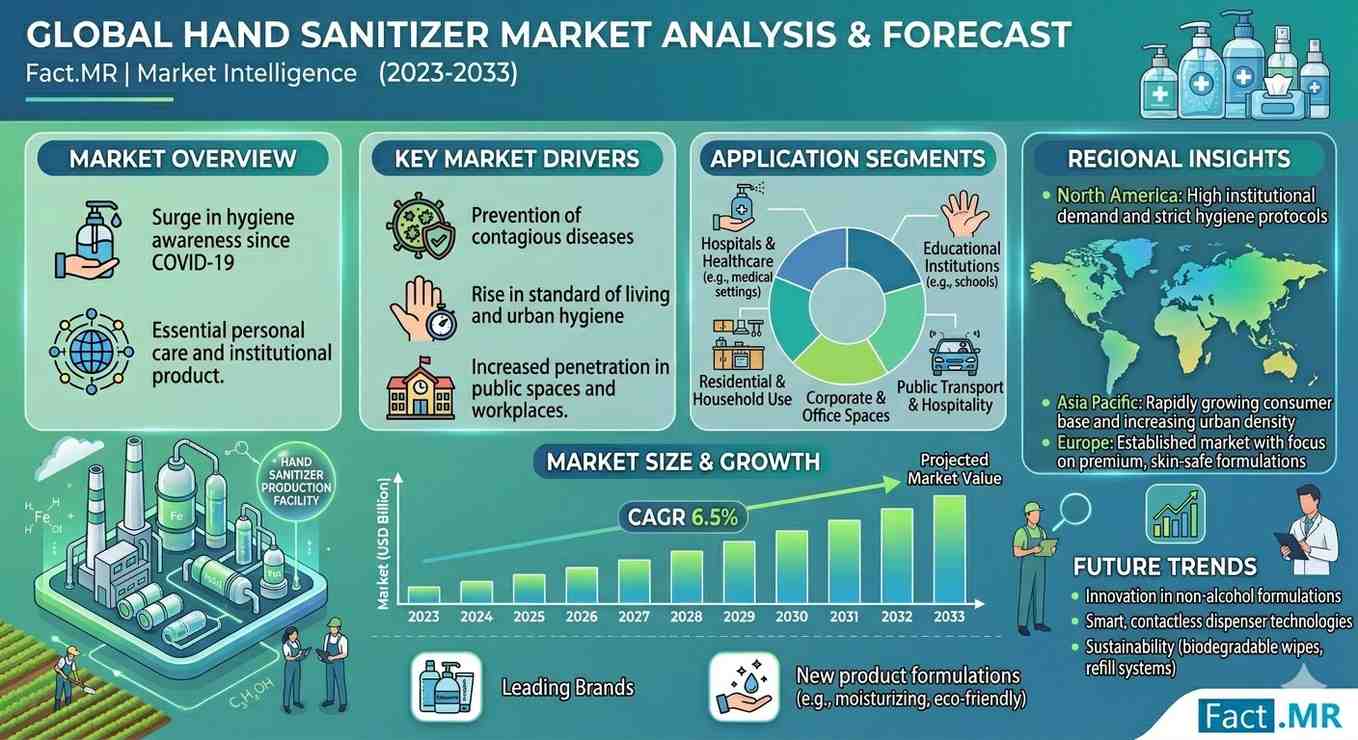
ROCKVILLE, MD, UNITED STATES, March 31, 2026 /EINPresswire.com/ -- The global hand sanitizer market has officially transitioned from a reactive, crisis-driven category into a resilient pillar of the personal care and institutional hygiene ecosystem. Valued at USD 1,854.2 million in 2025, the market is projected to reach USD 2,771.2 million by 2035, reflecting a steady normalization of sanitization into daily life.Today’s market is no longer defined by scarcity, but by sophistication. Decision-makers in healthcare, education, and corporate real estate are moving away from temporary solutions toward long-term, high-capacity dispenser ecosystems. For the modern consumer, the "sticky" habits formed over the last few years have evolved into a preference for dermatologically tested, moisturizing, and eco-friendly formulations that fit a mobile lifestyle.
Get Access Report Sample :
https://www.factmr.com/connectus/sample?flag=S&rep_id=4705
Quick Stats: Market at a Glance
2025 Market Value: USD 1,854.2 Million
2035 Projected Value: USD 2,771.2 Million
Forecast CAGR (2025–2035):1%
Leading Segment: Gel-based Sanitizers
Primary Formulation: Alcohol-based (Trusted Efficacy)
Growth Leader (Country): China (6.6% CAGR)
Strategic Drivers: Beyond the Bottle
The hand sanitizer landscape is being redefined by a focus on "Skin and Sustainability."
Institutional "Duty of Care": Large-scale framework contracts for hospitals and corporate campuses now mandate sanitizers as standard infrastructure. This has created a recurring revenue stream for suppliers who can offer batch traceability and dispenser compatibility.
The Premiumization Trend: Consumers are increasingly seeking botanical and herbal blends. Innovation is now focused on "sensory leadership"—formulations that offer the same 99.9% efficacy as traditional alcohol-based gels but with moisturizing additives and designer packaging.
Refillable Ecosystems: To combat plastic waste and lower shipping costs, the market is pivoting toward concentrated refills and pouch systems. In Japan and Western Europe, ingredient transparency and recyclable packaging have become critical competitive advantages.
Regional Engine Rooms: USA, China, and Japan
United States: The Hub of Institutional Contracts (3.8% CAGR)
The U.S. market is underpinned by robust demand from healthcare and education sectors. Procurement is increasingly favoring suppliers who invest in dispenser telemetry—IoT-enabled systems that notify facility managers when refills are low, ensuring 100% hygiene compliance in high-traffic zones.
China: Digital Commerce & Urban Density (6.6% CAGR)
China is the world's fastest-growing market, driven by a massive transition to urban living and a sophisticated digital economy. Super-app ecosystems and QR-code verification for product authenticity have made sanitizers a staple in every household, while local brands are rapidly scaling production to dominate mass-market channels.
Japan: Quality and Sensory Excellence (4.1% CAGR)
In Japan, the market values "Feel and Function." With an aging population, there is a specialized demand for skin-friendly products that prevent dryness. Japanese manufacturers are leading the way in compact, aesthetically pleasing designs that integrate seamlessly into the professional environment.
Category Insights: Gels Lead, Sprays Follow
Gel Sanitizers: Remain the dominant revenue base due to consumer familiarity and ease of application.
Alcohol-based Formulations: Continue to be the "gold standard" for clinical efficacy, though the rise of non-alcohol, botanical alternatives is capturing a significant niche in premium urban markets.
Omnichannel Growth: While supermarkets and pharmacies command the highest volumes, Direct-to-Consumer (DTC) online platforms are seeing a surge among younger demographics who prioritize niche, herbal, and design-led brands.
Competitive Landscape: The Resource Race
The industry remains highly competitive, with global giants like Reckitt Benckiser, GOJO Industries, and P&G leveraging their distribution scale.
Market Challenges: Raw material volatility (ethanol and isopropyl alcohol) remains a hurdle for smaller players.
Regulatory Rigor: Manufacturers are facing heightened scrutiny from the FDA and other global health authorities, making batch traceability and safety compliance the ultimate barriers to entry.
Conclusion: From Essential to Routine
The hand sanitizer market has found its "New Normal." It is no longer a discretionary item but a fundamental component of public health infrastructure. For stakeholders, the opportunity lies in dispenser-based ecosystems and sustainable formulation innovation that aligns with the global shift toward eco-conscious personal care.
Browse Full Report –
https://www.factmr.com/report/4705/hand-sanitizer-market
To View Related Report:
Non-alcoholic Hand Sanitizers Market https://www.factmr.com/report/non-alcoholic-hand-sanitizers-market
Hand Soap Market https://www.factmr.com/report/4718/hand-soap-market
Handbag & Purse Manufacturing Market https://www.factmr.com/report/handbag-and-purse-manufacturing-market
Second Hand Book Market https://www.factmr.com/report/second-hand-book-market
S. N. Jha
Fact.MR
+1 628-251-1583
email us here
Legal Disclaimer:
EIN Presswire provides this news content "as is" without warranty of any kind. We do not accept any responsibility or liability for the accuracy, content, images, videos, licenses, completeness, legality, or reliability of the information contained in this article. If you have any complaints or copyright issues related to this article, kindly contact the author above.
