

Top small business news from the world
Provided by AGP
Delirium Market to Hit USD 522 Million by 2032 at 5.45% CAGR | Maximize Market Research
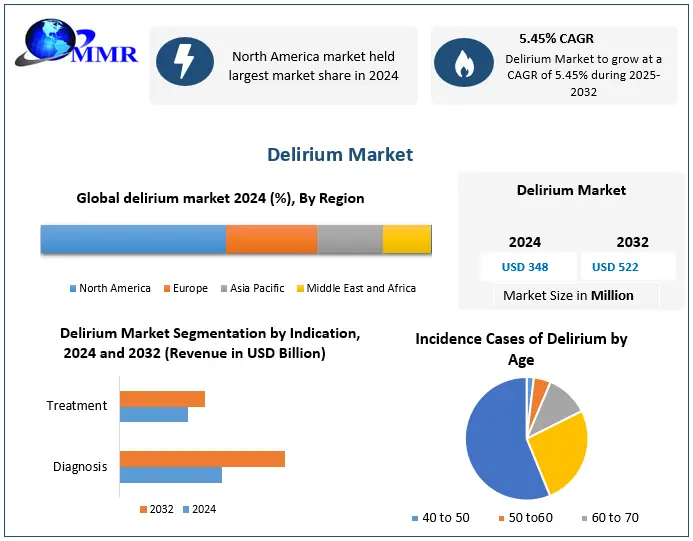
Delirium Market
Delirium care is shifting from antipsychotics to AI diagnostics, biomarkers, and non-drug ICU protocols.
Delirium is no longer a background diagnosis. It is a critical care priority and the market is finally responding with the diagnostic precision and therapeutic depth this condition demands”
ROCKVILLE , MD, UNITED STATES, May 4, 2026 /EINPresswire.com/ -- Global Delirium Market was valued at USD 348 Million in 2024 and is projected to reach USD 522 Million by 2032, growing at a 5.45% CAGR. Growth is anchored by an aging global population, the rapid rise of AI-based delirium diagnostic tools, and mounting clinical urgency around Hypoactive Delirium the most common yet most underdiagnosed subtype.— Maximize Market Research
Get Full PDF Sample Copy of Report: (Including Full TOC, List of Tables & Figures, Chart) @ https://www.maximizemarketresearch.com/request-sample/273014/
The Brain Condition Hiding in Plain Sight and the USD 522 Million Market Racing to Catch It
Delirium is not a rare fringe condition. It silently affects up to 80% of ICU patients, strikes 1 in 5 post-surgical adults over 65, and is one of the most costly, dangerous, and mismanaged neurological events in modern medicine. Yet for decades, it was dismissed as confusion a side effect, not a signal. The Global Delirium Market Analysis by Maximize Market Research marks a structural inflection point: from reactive management to proactive, AI-driven delirium detection powered by Neurofilament Light Chain (NfL) biomarkers, wearable ICU monitors, and the Confusion Assessment Method (CAM) the global standard for bedside diagnosis now embedded in hospital protocols across 40+ countries.
1.4 Billion Elderly by 2030 and Every One of Them Is a Delirium Risk
The Global Delirium Treatment Market is built on an unavoidable demographic reality. The WHO projects the global population aged 60 and above will reach 1.4 billion by 2030 and 2.1 billion by 2050 and older adults face exponentially higher delirium risk due to polypharmacy, cognitive baseline decline, and frequent surgical exposure. Post-operative delirium (POD) alone accounts for significant ICU admission extensions, adding an estimated USD 16,000–64,000 per patient in avoidable hospital costs. The market for geriatric delirium care is not a niche it is the coming standard of inpatient medicine. A 2024 study from Massachusetts General Hospital found that 68% of surgical patients over 50 developed hypoactive delirium post-operatively a figure that underscores how routine surgeries are quietly becoming neurological events.
The Silent Epidemic That Boardrooms and ICU Directors Can No Longer Ignore
The core challenge is visibility. Hypoactive delirium characterized by withdrawal, reduced motor activity, and lethargy is misidentified as sedation or fatigue in over 70% of cases. Unlike its hyperactive counterpart marked by agitation and restlessness, hypoactive delirium proceeds silently, lengthening ICU stays, increasing ventilator dependency, and accelerating long-term cognitive decline. For healthcare systems, the cost is structural: delayed detection means longer hospitalizations, heavier nursing burdens, and downstream dementia risk. Meanwhile, conventional pharmacological protocols relying on haloperidol and first-generation antipsychotics are increasingly scrutinized for efficacy and safety in elderly cohorts, creating white space for next-generation antipsychotic medication trends and non-pharmacological interventions. The incidence of ICU delirium reached up to 46.3% among critically ill patients, according to data published in Hindawi (2022) making it one of the most prevalent acute conditions in intensive care globally.
When AI Looks at a Patient and Sees Delirium Before the Doctor Does
The Global Delirium Management Market is being transformed by three parallel technology revolutions. First, AI-based tools for early delirium detection are transitioning from research pilots to clinical deployment: systems trained on inflammatory cytokines, tau protein patterns, and Neurofilament Light Chain (NfL) biomarkers now flag delirium risk hours before clinical symptoms appear. Second, wearable ICU monitoring devices provide continuous, 24/7 neurological surveillance closing the gap that intermittent CAM assessments leave open. Third, Tele-ICU platforms are extending specialist delirium care to rural hospitals and underserved geographies, democratizing access to ICU delirium prevalence management at scale. In April 2024, HealthNet Global launched a Tele-ICU program at Apollo Spectra Hospital in India demonstrating that real-time remote delirium monitoring is no longer theoretical. It is operational.
Not All Confusion Is Equal The Segments Separating Survivors from Statistics
The Global Delirium Market is segmented across type, diagnosis and treatment, and end user each revealing where clinical and commercial opportunity is concentrating.
By Type
Hyperactive
Hypoactive
Mixed
By Diagnosis and Treatment
Diagnosis
Treatment
By End User
Hospitals
Speciality Clinics
Homecare
Research Centers
Get Full PDF Sample Copy of Report: (Including Full TOC, List of Tables & Figures, Chart) @ https://www.maximizemarketresearch.com/request-sample/273014/
Two Regions. Two Urgencies. One Global Delirium Treatment Market on the Rise.
North America The Dominant Market, Now Going Algorithmic
North America commands over 38% of global Delirium Market share in 2024, anchored by the United States. The region's dominance is structural: advanced healthcare infrastructure, high ICU delirium prevalence recognition, strong R&D pipelines, and the fastest adoption of AI-driven diagnostics and wearable monitoring devices. U.S. government-funded research initiatives continue to drive delirium diagnostic market expansion, while hospital-level protocol mandates rooted in CMS quality benchmarks are forcing standardized Confusion Assessment Method (CAM) deployment across ICU networks. Ceribell launched a rapid EEG-based seizure and delirium detection tool that replaces traditional 30-minute setup with a 5-minute bedside deployment cutting diagnostic lag in critical care settings by over 80%.
Asia-Pacific The Fastest-Growing Region, Powered by Scale and State Investment
Asia-Pacific is the most dynamic Delirium Market Forecast 2032 corridor, driven by China's aging population of 300+ million over-60 citizens, India's expanding hospital infrastructure, and government commitment to AI-integrated healthcare. China is actively investing in AI-driven diagnostic platforms and delirium management protocols across tier-1 and tier-2 hospital networks. The region's manufacturing depth, combined with rising geriatric delirium care awareness, positions Asia-Pacific as the primary volume engine for global market growth through 2032. In April 2024, HealthNet Global deployed a Tele-ICU delirium monitoring system at Apollo Spectra India that provides remote neurological monitoring 24/7 proving that Asia-Pacific is not just a growth market but an innovation laboratory.
Four Forces That Are Quietly Making Delirium the Most Investible Condition in Critical Care
AI and Biomarker-Led Diagnostics: The delirium diagnostic market is the fastest-growing segment, with AI and machine learning algorithms improving diagnostic accuracy and enabling predictive delirium risk scoring before surgical procedures. Biomarkers including NfL, tau proteins, and inflammatory cytokines are creating objective, blood-test-confirmed diagnostic windows. Prolira's DeltaScan developed in partnership with European university hospitals uses AI-powered EEG to screen for delirium in under 3 minutes, transforming inpatient delirium management.
Non-Pharmacological Interventions on the Rise: Growing clinical evidence is shifting market share from pharmacological toward non-pharmacological delirium interventions. Calming music protocols, structured sleep optimization, early mobilization, and light therapy are entering formal hospital care pathways. Philips' VitalMinds program, launched in 2019 and now deployed across ICUs in 12 countries, uses a customized light treatment system to improve sleep quality and reduce delirium incidence with clinical studies showing a 34% reduction in delirium episodes in enrolled ICU patients.
Homecare and Remote Monitoring Emergence: ICU delirium prevalence management is extending beyond hospital walls. Wearable sensor systems capable of continuous cognitive function monitoring are enabling post-operative delirium (POD) therapeutics in outpatient and home settings reducing readmission rates and extending the commercial opportunity for device manufacturers into the homecare segment.
Specialized Hypoactive Delirium Protocols: As hypoactive delirium segment awareness rises, hospitals are developing dedicated care pathways. The ABCDEF bundle Awakening, Breathing, Coordination, Delirium Assessment, Early Mobility, and Family Engagement is becoming the gold standard for ICU delirium prevention, with documented reductions in ventilator days and hospital mortality. A landmark 2024 study published in the Primary Care Companion for CNS Disorders confirmed 68% hypoactive delirium incidence in post-operative adults over 50 establishing hypoactive delirium not as a subtype, but as the default condition requiring protocol-level intervention.
Pharma Giants, Diagnostics Disruptors, and Device Innovators: The Three-Front War for Delirium Market Share
The Global Delirium Market remains moderately fragmented, with pharmaceutical leaders, diagnostics innovators, and medical device companies all competing across different intervention layers. Otsuka Pharmaceutical and Novartis AG lead on targeted pharmacological therapies, while Ceribell, Inc. is redefining delirium diagnostic market leadership through EEG-based AI detection. Koninklijke Philips N.V. bridges the device-monitoring segment with ICU-integrated platforms. Meanwhile, Teva Pharmaceutical, Pfizer, Mylan N.V., and Zydus Group maintain competitive presence across generic antipsychotic formulations the backbone of acute delirium treatment globally.
Delirium Market Key Players:
Otsuka Pharmaceutical Co., Ltd. (Japan)
Mylan N.V. (US)
Teva Pharmaceutical Industries Ltd. (Israel)
Zydus Group (India)
Glenmark Pharmaceuticals Ltd. (India)
Pfizer Inc. (US)
Novartis AG (Switzerland)
Ceribell, Inc. (United States)
Koninklijke Philips N.V. (Netherlands)
Merck & Co. (US)
CereNova (US)
Fresenius Kabi MedTech Europe
Get access to the full description of the report @ https://www.maximizemarketresearch.com/market-report/delirium-market/273014/
FAQs:
Q1. Market Size & Forecast?
Ans. Valued at USD 348M in 2024; projected to hit USD 522M by 2032 (5.45% CAGR). Growth is driven by aging populations and AI-diagnostic integration.
Q2. Leading Regions?
Ans. North America leads with a 38% share due to advanced ICU infrastructure. Asia-Pacific is the fastest-growing market, fueled by China’s aging demographic and AI investment.
Q3. Growth Drivers?
Ans. Key factors include rising hypoactive delirium cases, wearable ICU monitors, and a shift toward non-pharmacological interventions and holistic care models.
Analyst Perspective
The Global Delirium Market is entering its most consequential growth phase. Analysts at Maximize Market Research observe that the convergence of AI-driven diagnostics, NfL and inflammatory cytokine biomarkers, and wearable ICU monitoring is fundamentally shifting this market from pharmaceutical-led reactive treatment to prevention-first, diagnostics-driven delirium management. The hypoactive delirium segment long neglected due to its quiet clinical profile now represents the most significant commercial and clinical opportunity through 2032. North America will maintain dominance, but Asia-Pacific's government-backed infrastructure investment will drive volume. Any hospital system, pharmaceutical company, or device manufacturer not yet building a delirium management strategy is operating with a significant blind spot.
Related Reports
Alzheimer's Disease Market:
https://www.maximizemarketresearch.com/market-report/alzheimers-disease-market/
Alzheimer's Disease Market by Drug Class, Route of Administration, Distribution Channel, and Region Global Forecast to 2032
Geriatric Care Market:
https://www.maximizemarketresearch.com/market-report/geriatric-care-market/
Geriatric Care Market by Service Type, End User, and Region Global Forecast to 2032
ICU Equipment Market:
https://www.maximizemarketresearch.com/market-report/icu-equipment-market/
ICU Equipment Market by Product Type, End User, and Region Global Forecast to 2032
Neuro-Monitoring Market:
https://www.maximizemarketresearch.com/market-report/neuro-monitoring-market/
Neuro-Monitoring Market by Product, Application, End User, and Region Global Forecast to 2032
Top Reports:
Genetic Engineering Market
Global Aspiration and Biopsy Needles Market
About Maximize Market Research Pvt. Ltd.
Maximize Market Research is a premier global consulting firm headquartered in Pune, India. Serving clients across 45+ countries, MMR delivers high-granularity market intelligence across Healthcare, Pharmaceuticals, Medical Devices, and Technology empowering enterprises with data-driven insights to make strategic decisions with confidence.
Domain Focus
This report falls under Maximize Market Research's Healthcare and Pharmaceutical domain, spanning critical care, neurology, geriatric medicine, diagnostic technologies, and hospital management across 45+ countries delivering the intelligence businesses need to innovate smarter and invest with precision in the evolving global delirium management landscape.
Lumawant Godage
MAXIMIZE MARKET RESEARCH PVT. LTD.
+91 96073 65656
akash.r@maximizemarketresearch.com
Visit us on social media:
LinkedIn
Instagram
Facebook
X
Legal Disclaimer:
EIN Presswire provides this news content "as is" without warranty of any kind. We do not accept any responsibility or liability for the accuracy, content, images, videos, licenses, completeness, legality, or reliability of the information contained in this article. If you have any complaints or copyright issues related to this article, kindly contact the author above.
