

Top small business news from the world
Provided by AGP
Off-axis bright- and dark-field OCT for non-destructive subsurface defect detection in silicon carbide
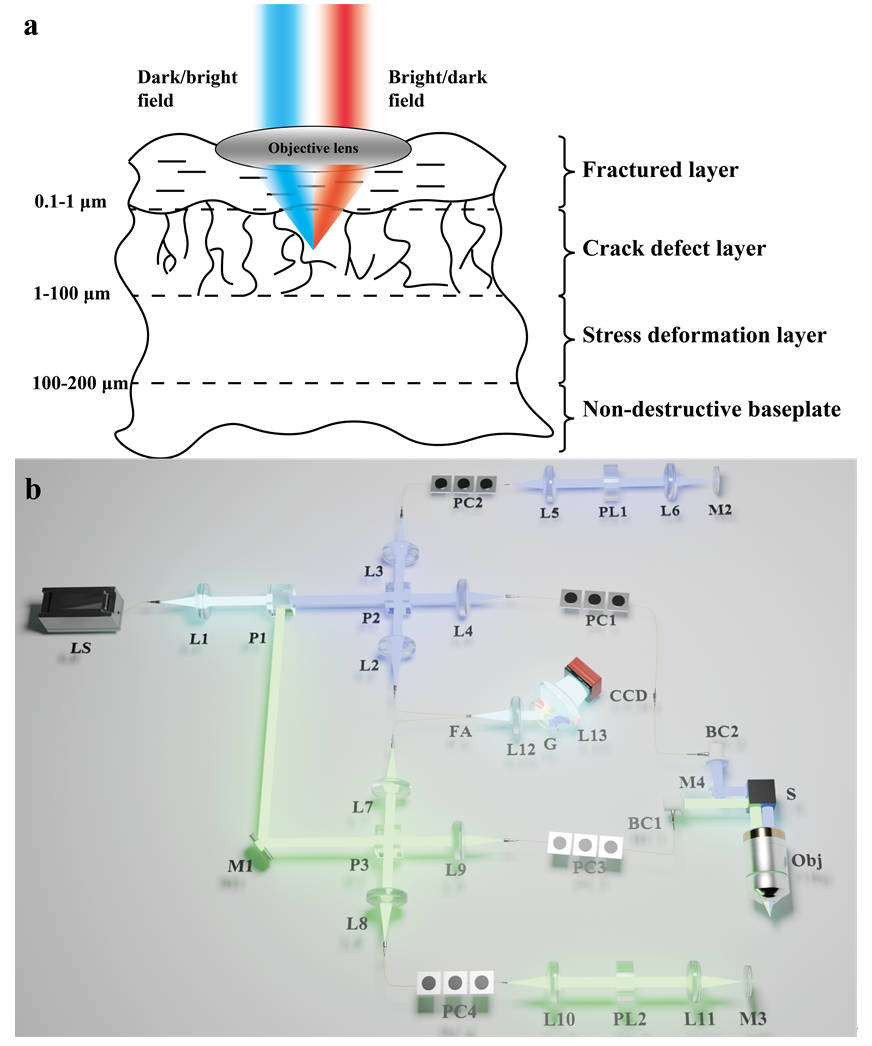
Off-axis BADF-OCT synchronous imaging detection principle and optical path diagram.
GA, UNITED STATES, May 12, 2026 /EINPresswire.com/ -- The team developed an off-axis bright- and dark-field OCT system with a custom-designed high-precision objective lens. By simultaneously collecting scattered signals at dual angles, the system achieves multi-angle nondestructive detection of subsurface defects in reaction-sintered SiC. Experimental validation demonstrates superior imaging depth, contrast, and defect recognition accuracy. This work provides a crucial technical solution for quality control of large-aperture high-precision optical components, with promising prospects for aerospace, defense, and civilian optical inspection applications.
As a high-resolution, non-destructive optical imaging technique, OCT is widely used in the fields of biomedicine and industrial inspection. However, traditional OCT faces challenges in industrial applications, including poor environmental adaptability, difficulties in balancing resolution and inspection efficiency, and interference from strong surface reflection noise that hinders imaging of deep-seated structures. The off-axis OCT configuration offers a new approach to the non-destructive detection of subsurface defects in SiC by enhancing the collection of multiple-scattered photons and suppressing specular reflection.
In a new paper published in Light: Advanced Manufacturing, a team of scientists, led by Yukun Wang from Changchun Institute of Optics, Fine Mechanics and Physics, Chinese Academy of Sciences, Changchun, 130033, Jilin, China have We propose an off-axis bright- and dark-field OCT (BADF-OCT) architecture. By simultaneously acquiring scattered signals from two angular channels, this approach captures complementary defect information that cannot be obtained with single-channel OCT, thereby significantly enhancing detection robustness. The system employs a broadband near-infrared light source (1100–1500 nm), balancing high axial resolution with deep penetration into SiC materials. In conjunction with a dual-channel fiber-optic array spectrometer, the system enables simultaneous bright-field and dark-field detection along with three-dimensional volumetric imaging.
The team specifically designed a nine-element spherical high-resolution objective lens for this system. Off-axis illumination effectively suppressed strong specular reflection interference from the sample surface, while the broadband light source ensured high coherence contrast even in environments with high stray light. The fiber array spectrometer achieved effective spatial filtering through light emission from the fiber ends.
The research team validated the system on reaction-sintered SiC samples. Regions with varying surface roughness were obtained by applying different polishing pressures (2 psi, 1 psi, 0.5 psi). Experimental results show that the average imaging depth in dark-field mode (115 μm) is greater than that in bright-field mode (102 μm), and dark-field images exhibit better intensity uniformity at deeper depths. After fusing the bright-field and dark-field images, the system avoids the strong light interference of bright-field imaging while retaining the advantages of dark-field imaging, namely greater depth and higher contrast.
By extracting cross-sections at different depths from 3D volumetric data and applying pseudocolor processing, the lateral distribution of subsurface defects can be visually revealed. A dual-path synergistic mechanism enables both optical paths to simultaneously perform bright-field illumination and dark-field collection functions, generating synchronized imaging from two angles and providing more comprehensive defect information. Synchronized bright-field and dark-field imaging, combined with fusion analysis, effectively mitigates detection uncertainties in single-mode OCT imaging, enabling precise defect localization and significantly improving defect detection rates and classification accuracy.
Original Source URL
https://doi.org/10.37188/lam.2026.060
Funding information
This research was supported by the Jilin Province Science and Technology Development Project (SKL202502022JC); Jilin Science and Technology Development Plan (No. 20240101029JJ); Synchronized high-speed detection of surface shape and defects in the grinding stage of complex surfaces (KLMSZZ202305); High precision wide dynamic large aperture optical inspection system for fine astronomical observation: National Major Research Instrument Development Project (62127901); Ultra-smooth manufacturing technology of large diameter complex curved surface: National Key R&D Program (2022YFB3403405); and Research on the key technology of rapid synchronous detection of surface shape and subsurface defects in the grinding stage of large diameter complex surface: International Cooperation Project (2025010157). This study was also supported by the Key Laboratory of Optical System Advanced Manufacturing Technology, Chinese Academy of Sciences (2022KLOMT02-04).
Lucy Wang
BioDesign Research
email us here
Legal Disclaimer:
EIN Presswire provides this news content "as is" without warranty of any kind. We do not accept any responsibility or liability for the accuracy, content, images, videos, licenses, completeness, legality, or reliability of the information contained in this article. If you have any complaints or copyright issues related to this article, kindly contact the author above.
